Individual practice
Work with me.
120 minutes to understand your default state. 6 to 12 weeks to train it.
One assessment that decides the path. A standard 6-week programme, with the option to extend.
You will get the most out of this if
- You consider yourself impacted by stress.
- You are already taking care of your health, but something still feels off.
- You notice patterns you cannot fully explain. Chronic tension, stress spikes, poor recovery.
- You want data plus guidance, so you can optimize your response and recovery.
- You have heard about HRV and want to understand what yours is actually doing.
- You are willing to practice consistently and track progress.
Skip this if
- You want a fast result or a one-off session.
- You are not ready to practice between sessions.
- You want advice only, without training or follow-through.
Step 1 · The assessment
- 6 biomarkers read
- DRI scored
- The system holding the pattern named
- Result analysis and report
- Personalized programme design
Step 2 · The programme
Standard6 weeks of training
€620 excl. VAT
The standard programme. Most clients start here.
- 6 sessions · 60 to 120 minutes each
- DRI re-assessment at the end
- App and dashboard access for guided home protocol
- WhatsApp access between sessions
- Portable skills tailored to personal goals
Between sessions
Daily training in your pocket.
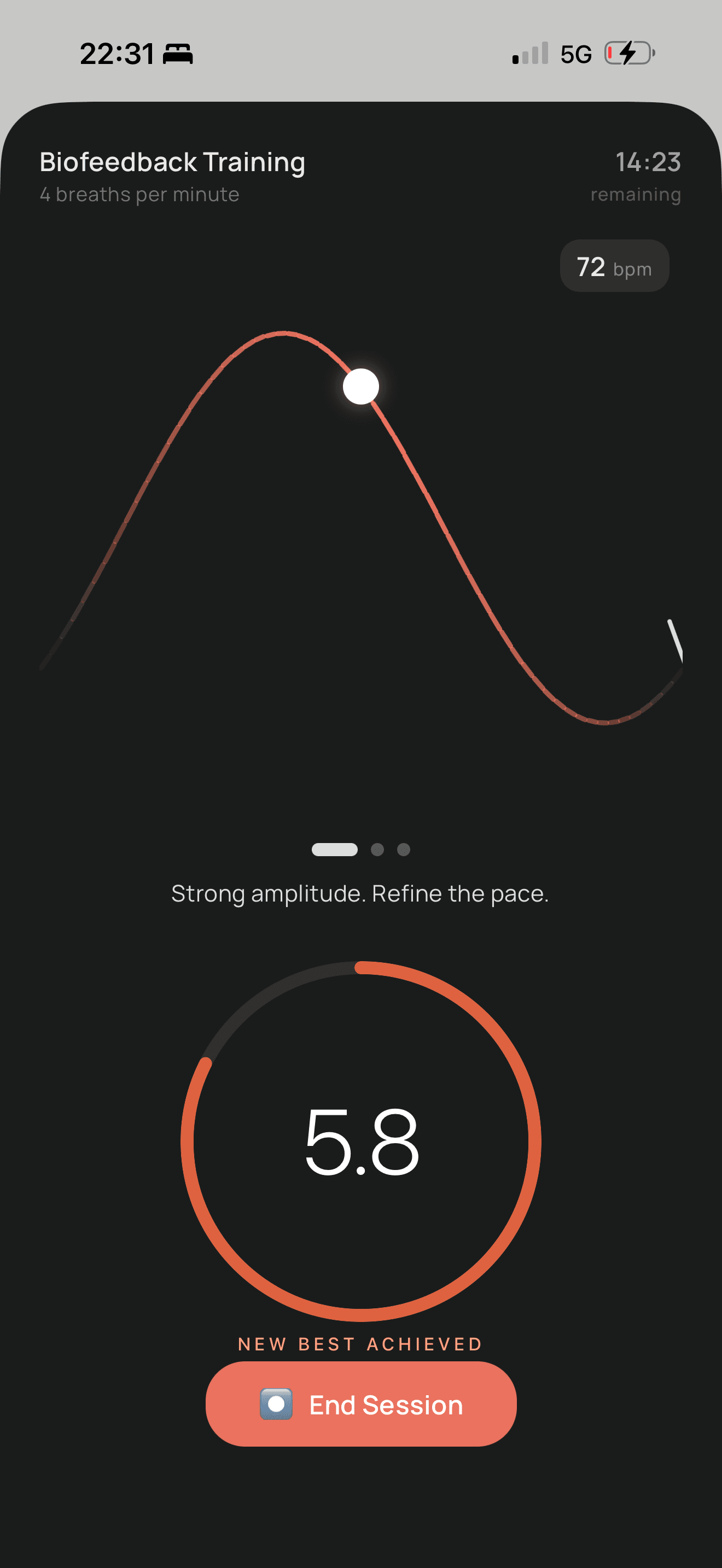
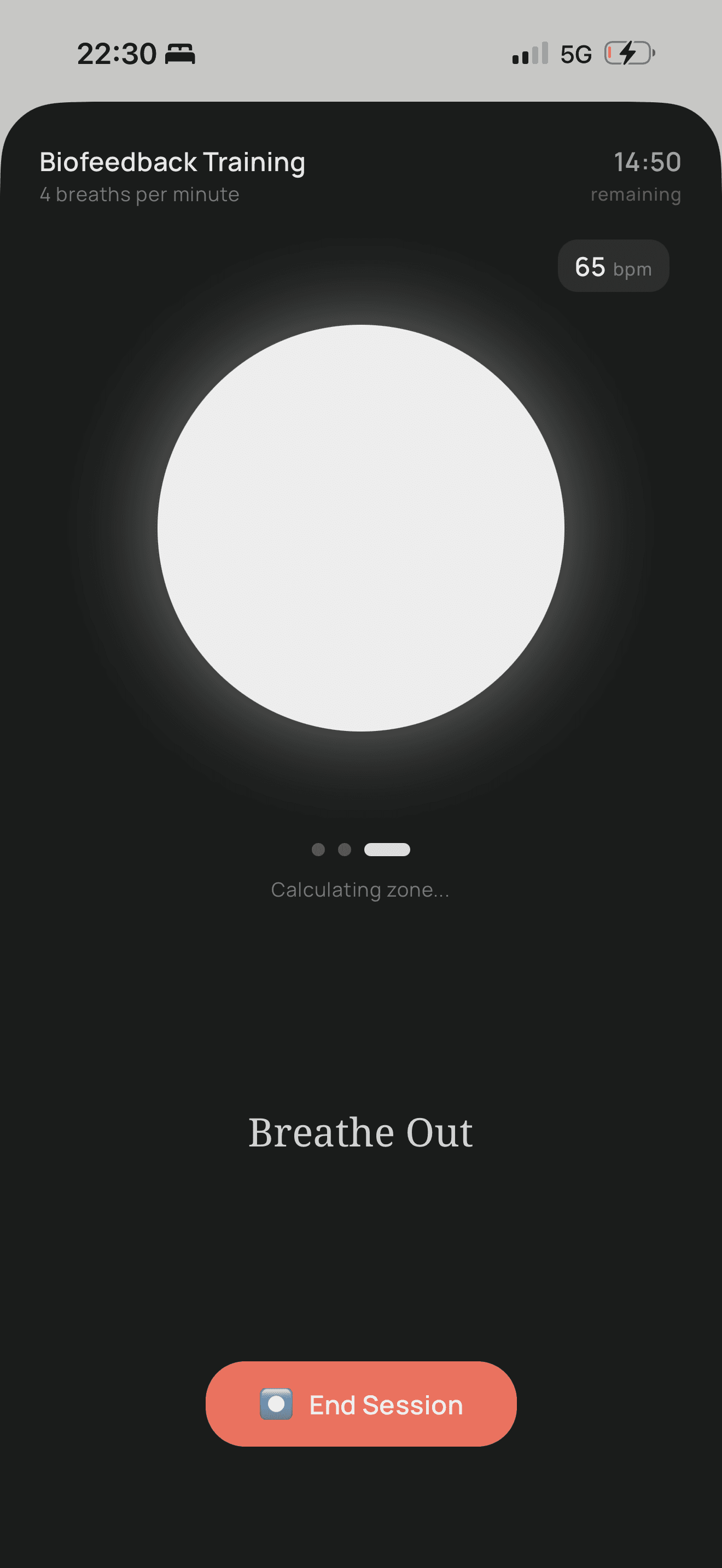
Guided home protocol, live biofeedback, and the same metrics you saw in your assessment. Practice consistency is what shifts the default.
All programmes start with the €220 assessment. Continue into the programme after the assessment and get a 20% discount on the programme price. Payable in two instalments.
If your default needs more time, extend the standard with one of two add-ons.
+2 WEEKS
+€160
Stress-load integration.
Two extra sessions to fold the trained response into the moments where stress actually shows up. Recommended if your work or life has predictable high-load windows.
Total: 8 weeks · €780 excl. VAT
+6 WEEKS
+€300
Deep integration.
Six extra sessions and a second default read. Recommended for stubborn defaults that need more time to shift, or if you want to train against real-load conditions across a full quarter.
Total: 12 weeks · €920 excl. VAT
When changes show up.
Wk 1–2
Wk 3–4
Wk 4–5
Wk 6–8
Wk 8–12
Everyone's timeline is different. These are patterns I observe across clients, not promises.
- Yes. Every programme is calibrated off the assessment. Without the assessment, the protocol would be guesswork.
Most apps and wearables track one metric (usually heart rate) and give you generic suggestions based on population averages.
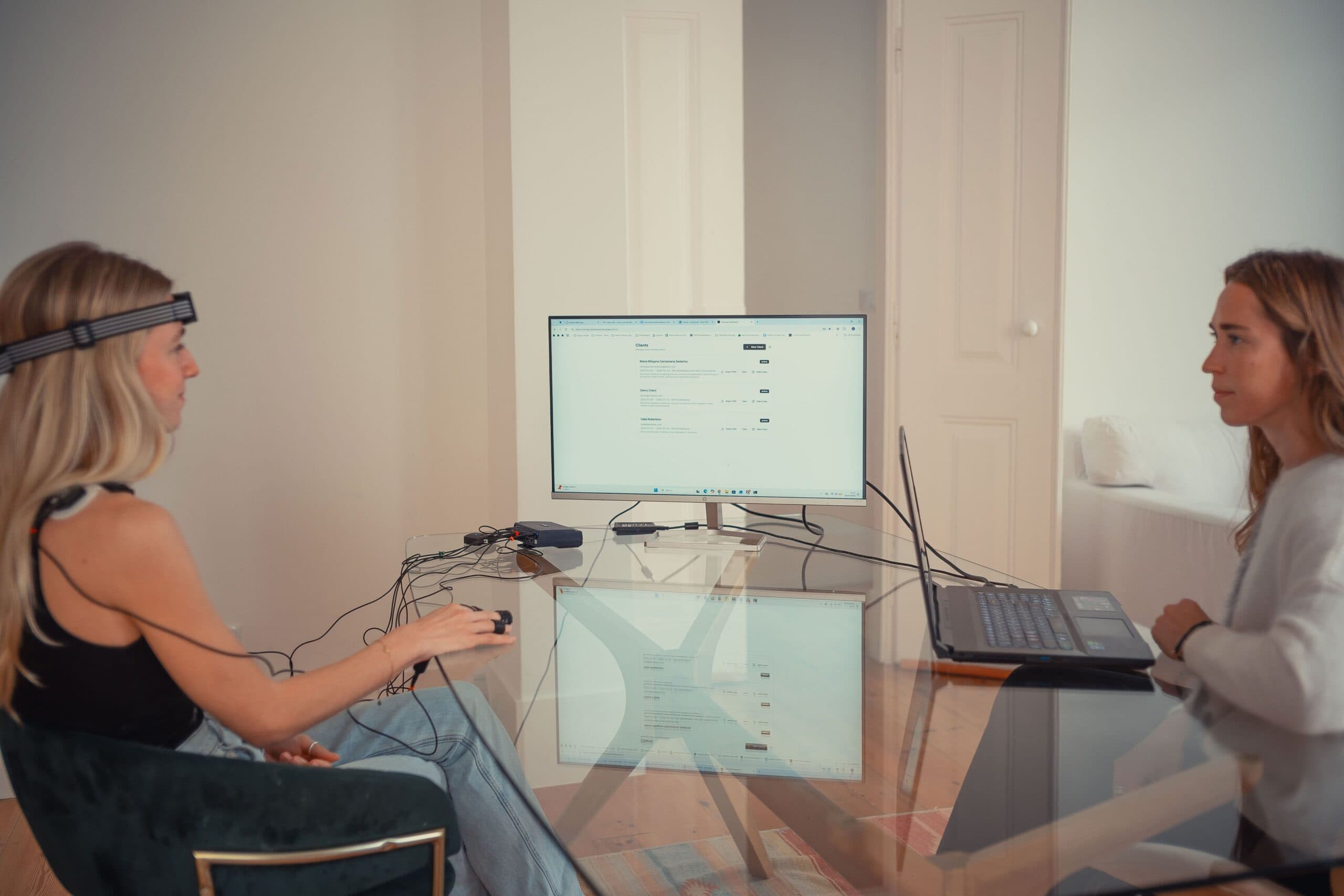
I measure 6 biomarkers simultaneously using research-grade equipment (Thought Technology Flex Comp), and I build a protocol around what your data actually shows. Every session is guided in real time, adjusted to what your nervous system is doing.
A wearable tells you that you are stressed. Biofeedback training teaches you how to read your body and change its responses.
This is skill training. The method works on what your body is doing right now, distinct from the work therapy does on memory and meaning. Most of the people I work with are high-functioning, capable, and already doing well by most standards. They come because they want to understand their own stress response better and learn how to regulate it on demand. They may have some underlying conditions which exacerbate their symptoms, but not always.
Anyone wanting to understand how their stress response works can benefit from learning the skill.
Honestly, it varies. Some people notice shifts in breathing patterns and tension awareness within 2 to 3 sessions. Skills typically become portable (meaning you can use them outside of sessions, without sensors) by week 4 or 5.
The full effects of a programme compound over time, which is why consistency matters more than speed. I will never promise a timeline because your nervous system is not on anyone else's schedule.
Yes. Biofeedback training complements other forms of care. It is not a replacement for therapy, medication, or any care you are currently receiving.
I work alongside therapists, coaches, and physicians regularly. If you have a care team, I am happy to coordinate with them so your training supports what you are already doing.
The initial assessment must be done in person at my practice in Lisbon. That is non-negotiable because the full sensor setup requires it.
After that, training sessions can be done virtually or in person, depending on what works for you and the programme we choose.
Home practice is independent, using the professional sensors and app I provide.
The primary system is the Thought Technology Flex Comp. It is research-grade, used in research and care settings worldwide, and measures multiple biomarkers simultaneously through non-invasive sensors placed on the skin.
I also use Mindfield Biosystems for EDA, peripheral temperature, and muscle tension sensors, and the Medi headband for HEG home training.
For home practice and heart rate variability training, I use the Polar H10 and HeartMath Inner Balance. The full suite of home training equipment is available so the practice carries between sessions.
I test the latest equipment and add it as it comes out.
Most clients run the standard 6 weeks (€620) and integrate from there. The assessment shows whether your default needs more time to shift than 6 weeks gives you. If it does, I will recommend one of two extensions:
- +2 weeks (+€160) for stress-load integration. Two extra sessions to fold the trained response into the moments where stress actually shows up. Recommended if your work or life has predictable high-load windows.
- +6 weeks (+€300) for deep integration. Six extra sessions and a second default read. Recommended for stubborn defaults that need more time to shift, or if you want to train against real-load conditions across a full quarter.
All prices exclude VAT.
15 to 20 minutes daily with professional sensors and a guided app. The protocols are adjusted based on what we see in your sessions, so the practice evolves as you progress. This is not optional. Sessions build awareness and teach the skill.
Home practice is where the skill consolidates and becomes yours. Without it, progress stalls.
Yes. Biofeedback is grounded in psychophysiology and supported by decades of peer-reviewed research. HRV biofeedback in particular has a strong and growing evidence base for stress regulation, autonomic flexibility, and performance.
I hold 5 biofeedback certifications through BFE, MindMedia, EGBNV, and HeartMath, and my MSc in Applied Neuroscience is from King's College London.
My own research examines the integration of biofeedback with movement-based therapies. It is an established field with serious science behind it.