A nervous system has two directions. Most people are fluent in one of them. The gas pedal (sympathetic branch) engages on its own. The brake (parasympathetic branch) has to be trained.
The method treats the brake the way a coach treats a squat: a motor skill with shape, load, and progression.
02What I measure
Multiple systems that give one complete picture.
To understand how your nervous system responds, I observe patterns across 4 physiological systems using research-grade biofeedback equipment. The same instruments used in research labs.
You feel it everywhere. So do I.
How quickly your system activates, how intensely it responds, and whether it stays activated long after the trigger is gone. This reveals whether your body is running in a constant state of readiness, burning through resources even when there's no threat.
It shows up as elevated muscle tension, heightened skin conductance, shallow breathing, or a heart rate that stays elevated when it should be settling.
HRV dropsSkin spikesMuscle bracingBrain shift
03What you receive
A reading you can hold. A practice you can carry.
The assessment becomes a dashboard. The training becomes an app. Both speak the same language as the live session.
lucieschnitzer.com/dashboard
←S. Marquez/Assessment
Import report
Client
S. Marquez
14 Apr 2026 · 120-min stress
62DRI
Moderate Resilience
Quadrant
Settled
Resilient ●
Shutdown
Activated
RecoveryTrajectoryRelaxationBaseline
Recovery breakdown · 6 systems
Cardiac
78
Respiratory
54
Electrodermal
71
Muscular
48
Prefrontal
66
Thermal
60
Recovery trajectory · 5-cycle session
C1C2C3C4C5
Relaxation · 4 systems
Gas Pedal · Sympathetic
EDA tonic
68
EDA phasic
55
Brake · Parasympathetic
HRV high freq
72
Vagal tone
64
Body Tension · Muscular
sEMG trapezius
41
sEMG forearm
50
Thinking Brain · CNS
HEG prefrontal
66
HEG sustain
58
Baseline profile · resting reference
HR rest
62 bpm
HRV rmssd
48 ms
Resp rate
13 /min
Skin cond
8.4 µS
Temp peri
33.2 °C
HEG ratio
1.18
Generated by Default Resilient practitioner dashboard · confidential — for client + practitioner only
Dashboard · assessment results
Training · resonance
Insights · progress
04Score · Default Resiliency Index
62
Default Resiliency Index · 0–100
How to read your score.
Six markers, measured the same way every assessment.
The score reflects what your nervous system did across the 120-minute reading. A physiological pattern, scored on the same scale as the next assessment. Independent of how the day felt or what you reported.
The number reads alongside the conditions.
A 62 at rest reads differently from a 62 under load. Each score is interpreted with what was happening when the measurement was taken.
Training moves the system. The score follows.
Training targets the system holding the pattern. The number changes as the underlying physiology changes.
05The four patterns
Four signatures.
Each pattern is current. This is your pattern today.
01 · pattern
The Settled Pattern
Settled
Resilient
Shutdown
Activated
Recovery →Stress →
Steady through stress.
Low reactivity, high recovery. A nervous system that stays even when stressors arrive. When activation does come, it resolves cleanly back to default. Stable by disposition; rarer than it looks from outside.
02 · pattern
The Resilient Pattern
Settled
Resilient
Shutdown
Activated
Recovery →Stress →
Activates fully. Recovers cleanly.
High reactivity, high recovery. A nervous system that responds fully to what is in front of it and then resolves when the event ends. Fully activated when activation is called for; recovery comes back cleanly. The target state most clients arrive at after about 12 weeks of training.
03 · pattern
The Shutdown Pattern
Settled
Resilient
Shutdown
Activated
Recovery →Stress →
Reads calm from outside. Runs depleted underneath.
Low reactivity, low recovery. A nervous system that has learned to suppress rather than respond. From outside reads as calm; inside there is often flatness, unsourced fatigue, a sense that things are less than they used to be. Usually develops in environments where reactivity felt unsafe.
04 · pattern
The Activated Pattern
Settled
Resilient
Shutdown
Activated
Recovery →Stress →
Wired but tired. Cannot come down.
High reactivity, low recovery. The pattern most high-performers carry. On, and cannot come down. Wired but tired. Every incomplete recovery leaves residual activation; the default drifts upward over time.
06Train · Resonance → Release → Integrate
01
Resonance
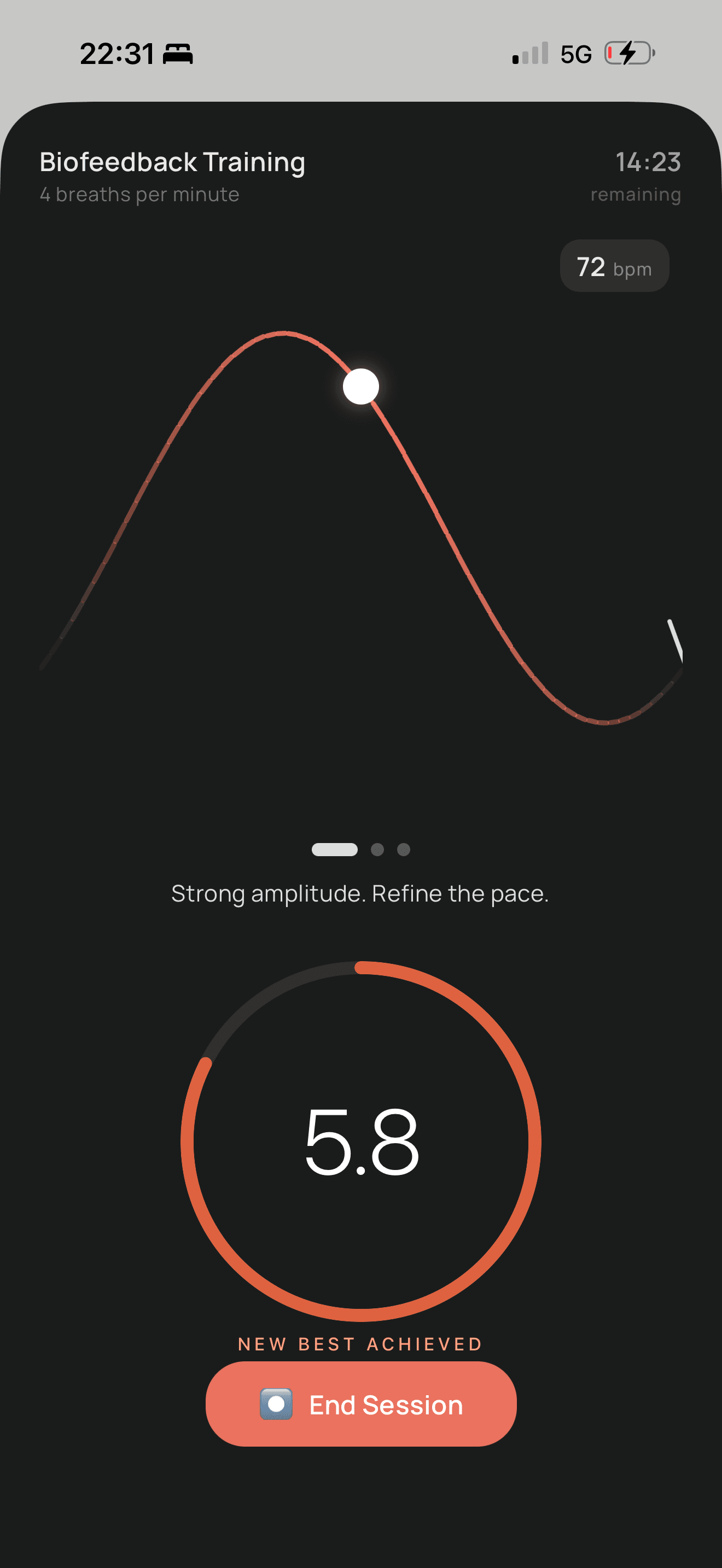
HRV Resonance frequency training (Lehrer et al.). Find the breathing rate, typically 4 to 7 breaths per minute, where the heart, breath, and blood pressure regulator couple and the body's systems resonate at the same frequency. Located with a breath sweep and 6 convergent algorithms. Strengthens the brake, the vagal tone the nervous system uses to shut threat signals down, and increased HRV.
02
Release
System-specific training across skin conductance, temperature, muscle tension, and prefrontal blood flow. Release the learned patterns holding tension so the brake has less to suppress. System by system, the pull quiets and the default shifts.
03
Integrate
The skill becomes portable. Read your own body, apply skills in daily life, maintain without sensors. A resilient default that carries into meetings, conflict, training, sleep onset.
Where this fits
Complements therapy. Trains physiology.
Trains physiology.
The method reads what the body is doing in real time. Heart, breath, tension, skin. Each gets trained on its own measurable signal. It works alongside therapy, which addresses memory, narrative, and meaning.
Closes the loop with data.
Sensors translate every breath, tension shift, and skin response into real-time feedback. That feedback is what makes the practice trainable.
Scored every session.
Every session produces measurements. Progression follows the data, session by session.
07The research behind the method
Built on the research, not in spite of it.
The method draws on published work across HRV biofeedback, autonomic regulation, prefrontal training, and the four measurement systems the assessment reads. The full citation list is below. Each entry links to the canonical paper.
24 citations
01
HRV Resonance Frequency Training
Specific breathing rates (4 to 7 breaths per minute) synchronize heart, breath, and blood pressure regulation through vagal coupling.
Dawson, M. E., Schell, A. M., & Filion, D. L. (2017). The electrodermal system. In J. T. Cacioppo, L. G. Tassinary, and G. G. Berntson (Eds.), Handbook of Psychophysiology (4th ed., pp. 217-243). Cambridge University Press.
The mechanism reference for 'EDA reflects sympathetic activity'.
07
Respiratory Patterns
Breathing rate, depth, and CO2 chemistry shape autonomic state.
Yucha, C. B., & Montgomery, D. (2008). Evidence-Based Practice in Biofeedback and Neurofeedback (2nd ed.). Association for Applied Psychophysiology and Biofeedback (AAPB).
AAPB official evidence ratings — Level 4 efficacy for thermal biofeedback.