I built this practice because no one could show me what my own body was doing.
I help people understand how their nervous system responds to everyday stress, and train regulation skills using real-time biofeedback.
Who am I?
I help people understand how their nervous system responds to everyday stress, and train regulation skills using real-time biofeedback. I know how it feels to work in high-pressure environments.
My Story
I deeply understand the feeling of being dysregulated because thats all I knew. That feeling brought me to this work.
High pressure isn’t something I discovered at work. I grew up in it. Three brothers, intense family dynamics, and the kind of environment where you learn early to put pressure on yourself before anyone else does. That was my normal long before I had a job title.
Then came the career that matched the pattern. Industrial Engineering at Northeastern Uni. Technology consulting at Veeva Systems in life sciences. Early-stage AI at Omdena, where I helped grow the community from a small team to thousands of engineers across 100 countries.
I was good at it. I was also quietly running on fumes.

Not in the way that looks dramatic from the outside. In the way that lives in your body. Shoulders that never fully dropped. A nervous system stuck in overdrive that I mistook for drive. Recovery that felt like a concept for other people. I thought I was functioning well. I had been living in the extremes my whole life without knowing it.
I found biofeedback because I started asking a question I couldn’t stop asking: Why does my body keep responding like this when nothing is actually wrong?
That question took me to King’s College London, where I hold a MSc. in Applied Neuroscience. It took me through five professional certifications across Europe. It took me into research on how the prefrontal cortex responds to training, and whether combining movement therapy with neurofeedback changes outcomes over time.
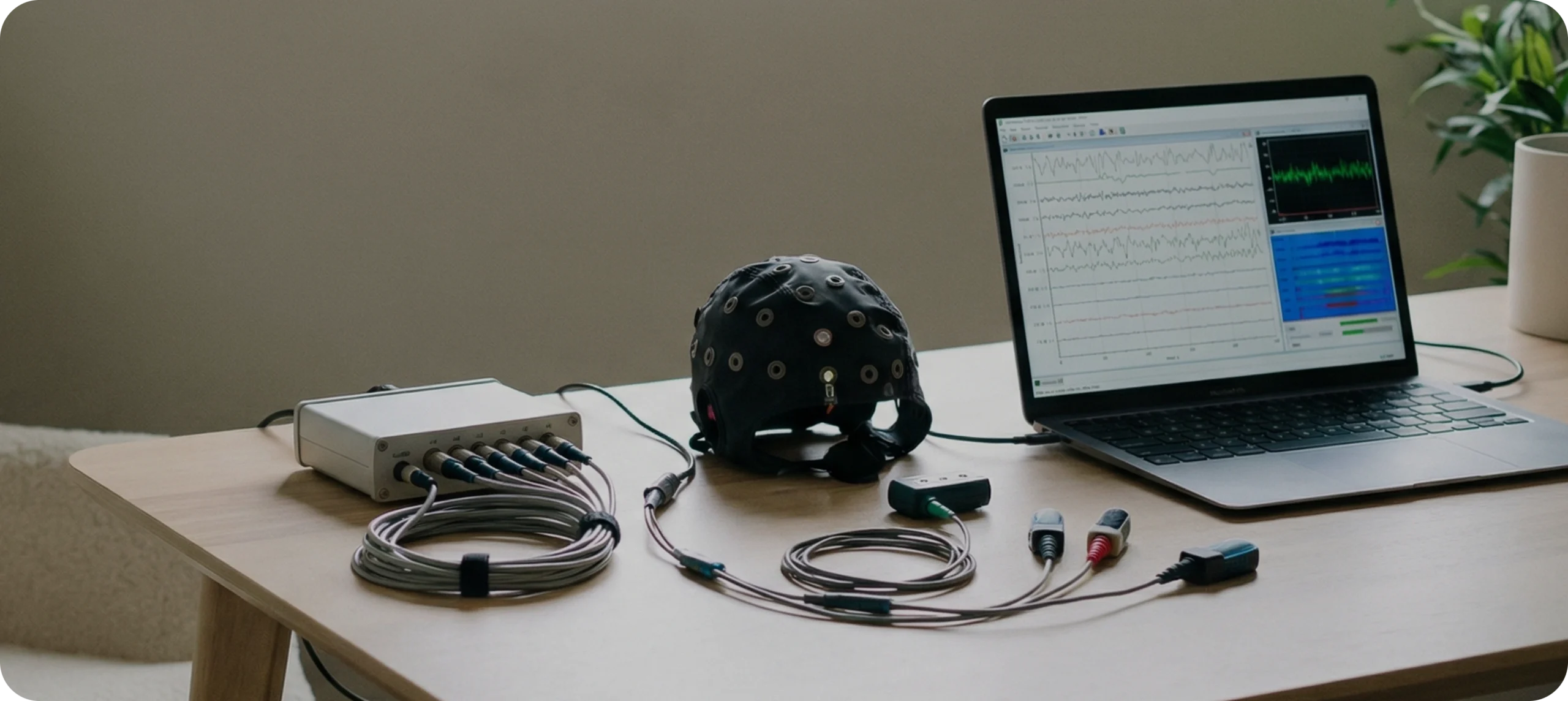
It took me from reading about the nervous sytsem to mesuring it, live, in real people, session after session.
This wasn’t a career change. It was convergence.
Every role I’ve held has been about the same thing: understanding complex systems, finding patterns that aren’t obvious, and building something that actually works. The system just changed. From industrial processes to the human body. From closing deals to reading physiological data. From optimising operations to helping someone see, for the first time, what their own stress response looks like on a screen.
What I Bring to this Work
Systems Thinking
Pattern Recognition
Precision over Guesswork
I also bring something the technical background alone wouldn’t give me. I know what it feels like to be the person in the chair. To see your own data and realise your body has been telling a story you weren’t hearing. I deeply understand dysregulated people because I am one. That’s why I came to this work.
Training and Credentials
MSc Applied Neuroscience, King's College London Graduating April 2026
Modules in neurophysiology, psychophysiology, clinical neuroscience, and research methods. My thesis examines whether combining movement therapy with HEG prefrontal cortex training alters trajectories of prefrontal oxygenation compared to training alone. In plain terms: I’m researching whether pairing body-based therapies with brain-based training produces better outcomes than either approach by itself. That question sits at the centre of how I design programmes.
BSc Industrial Engineering, Northeastern University 2012 to 2017
Foundations in systems thinking, data analysis, and process optimisation. Minor in Business Administration.
Biofeedback and Neurofeedback Certifications
Biofeedback Federation of Europe (BFE) March 2025
Foundations of Heart Rate Variability Training: Basics and Advances. 12-hour BCIA-accredited workshop at the 23rd BFE Meeting in Brescia, Italy. Taught by Donald Moss, Inna Khazan, and Frederic Shaffer.
Behavioral Medicine Research and Training Foundation (BMRTF) June 2025
Anatomy and Physiology, 45-hour continuing education course. BCIA-approved, APA-accredited. Directed by Richard A. Sherman, PhD
MindMedia Academy June 2025
Biofeedback Didactic E-Course, 42 hours. Covers BCIA Blueprint knowledge areas including HRV, sEMG, autonomic nervous system applications, respiratory biofeedback, skin conductance, and intervention strategies. Instructor: Phillip A. Hughes, PhD, BCB.
EGBNV (European Society for Applied Biofeedback) October 2025
Certified Biofeedback Trainer and Neurofeedback Trainer. European biofeedback and neurofeedback training certification.
HeartMath Institute December 2025
Coherence-based HRV training and resilience protocols.
Equipment and Modalities
I work with medical-grade biofeedback equipment including Thought Technology Flex Comp, Polar H10, HeartMath Inner Balance, and Mindfield Biosystems.
Modalities I train:
HRV biofeedback
Heart rate variability
HEG neurofeedback
Prefrontal cortex blood flow
sEMG
Surface muscle tension
Skin conductance
Arousal and activation
Peripheral temperature
Stress vs. recovery state
Respiratory biofeedback
Breathing mechanics
How I work
I measure how your nervous system actually responds. Not how you think it responds, not how you describe it, but what shows up in the data when I put sensors on your body and observe.
From there, I build a personalised training programme around your patterns. We work together, session by session, until you can recognise and shift those patterns on your own.
The work is structured and built on psychophysiology . It is also personal. Because the data only matters when the person looking at it finally understands what their body has been trying to tell them.
Read more about the training process and what sessions look like.
Ready to see your own patterns
You’ve read enough. You know whether this fits.
A 20-minute consultation lets us talk about what’s going on, what you’ve tried, and whether this approach fits. No pressure. No commitment beyond the conversation.